

A Journey Into the Past: How Sofia Became a Capital of Bulgaria
The history of the largest city in Bulgaria – Sofia, begins long before the creation of our country. The earliest data on the inhabitation of the territory are from the early Neolithic. Over the centuries the city did not stop developing, but it was declared the capital only in 1879.
Before that we can trace interesting events from its prehistory, as well as from the Thracian, Roman and Medieval eras. We will tell you about them some other time, and now let’s follow when and how the city rises to the most important administrative center of the Third Bulgarian State.
Name Development
Today’s Sofia in the past bore different names. The oldest documented is Serdonopolis (translated from Greek “city of the Serds”) and according to researchers the Serds inhabited the area in the first century BC. Emperor Trajan officially gave the city the name Ulpia Serdica, often abbreviated only to Serdica. After the region joined Bulgaria at the beginning of the 9th century, it became known as Sredets, and the name Triaditsa is also used in ancient Greek sources. In the 14th century it was already mentioned as Sofia on behalf of the Church of St. Sophia.
How Did Sofia Become a Capital?
For centuries, Sofia has played a particularly important role as a central center and a natural crossroads connecting East and West. And indeed, as the motto of our capital states, the city is growing, but not aging, and therefore it has more than 7,000 years of history.
After the Liberation of Bulgaria from Turkish slavery, a temporary Russian government was formed with headquarters in Plovdiv, which was significantly larger in terms of population at that time. The head of the temporary administration is the Russian prince Alexander Dondukov-Korsakov, who later moved to Sofia and this became a sign of the future strategic location of the city.
A little later, at the suggestion of Marin Drinov, the city was chosen as the capital of the Principality of Bulgaria (April 3, 1879). This led to a rapid increase in population and Sofia became a large and important political, administrative, economic, scientific and cultural center.
The Early Capital
When Sofia was declared the capital, the population was just over 11,000, and urbanization lagged far behind. At that moment there were only two schools, almost no administrative buildings, and only 3,000 houses. But the situation changed very quickly, because the city had good communication lines and a key location for the construction of the future railway network of the Principality.
Transformation of Sofia
In the same year (1879) the first urban plan of Sofia was prepared by the city engineer S. Amadie, who transformed the city. Some of the most prominent architects and builders at that time came to help build the new look. Bold changes began and the center shifted from the square at Banya Bashi Mosque to the square around the Cathedral “St. King ”(today’s Holy Sunday Church).
The first city architect – the Czech Antonin (Adolf) Kolar, created the Ministry of War, Hotel Bulgaria, the Military Club, etc., and Chitalishte Slavyanska Beseda, the buildings of the Bulgarian Academy of Sciences, the Bulgarian National Bank and the mausoleum of Prince Alexander Battenberg were conceived by the Swiss Hermann Meyer. A famous Viennese architect of Bulgarian origin (Konstantin Jovanovic) designed the building of the National Assembly. The emblematic Eagle Bridge, which is considered the symbolic gate of the city, was designed by the chief architect Kolar and Vaclav Prosek in 1891. The name, as you know, comes from the bronze statues of eagles on the bridge.
********************************
If you have a way to the capital Sofia, welcome to Art Hotel Simona, which is located very close to the city center. We will accommodate you in interesting design rooms and we will make sure that you have eaten well with the specialties in the Simona Restaurant.
We are expecting you!

The Metamorphoses of a Favorite Bulgarian Salad – the Shepherd’s
The favorite Bulgarian salad is the Shopska salad. However, the Ovcharska is wonderfull, too.
Prototype of the Shepherd’s Salad
Nowadays the Ovcharska salad is very popular and we often experiment with what we have in the fridge, but it actually originates from a recipe with less ingredients. The prototype is the Rhodope salad – Shopska, but without cheese. Cubes of chilled boiled potatoes and /or ripe well cooked and chilled beans are added to it. If you don’t like beans, there is another option – with a topping of slightly acidic broth with veiled eggs and pieces of meat (pastrami, fillet, dried meat).
According to the original recipe, dried samardala (the secret ingredient of the Bulgarian colored salt), garlic and vinegar are also added.
And something very important – in the original Rhodope salad no mushrooms, parsley and olives are used. However, these are put in the modern versions of both the Rhodope and the shepherd’s salad.
History of Shepherd’s Salad
Shepherd’s salad authorship is not entirely clear, but it is certainly known that it has nothing to do with the shepherd’s table, as most of you probably assume. As we mentioned, the classic recipe for Shepherd’s salad starts from the Rhodope salad. In the 1960s, however, it was changed due to the prescription innovations of Balkantourist and acquired a new look, and with it a new name.
Officially in the menus of restaurants Shepherd’s salad found a place in the 90s of last century and very quickly gained popularity. The reason for this is the fact that the flavors combine very well and it is established as one of the favorites in our country.
Turkish Influence
Our Shepherd’s salad is traditional for bulgarians, but it coexists with a very similar Turkish salad – Choban salad. Experts suggest that the Turkish version is a common traditional basis for salads prepared in the Balkans within the Ottoman Empire by Bulgarians, Serbs, Greeks and Turks.
How to Prepare Shepherd’s Salad in Simona Restaurant?
This much-loved traditional salad is also part of the menu at Simona Restaurant. And here are the steps for its preparation:
The shepherd’s Salad at the Simona Restaurant

To begin with, blanch mushrooms, bake a red pepper and boil an egg for 6 minutes. Then peel and cut a cucumber into large cubes, tomato – again into cubes, and onion – into small pieces. We also cut ham and grate yellow cheese. Finally, grate the cheese and decorate with the egg, parsley and olive kalamata cut into 4 equal parts.
What will surely impress you with us, apart from the great taste, of course, is the presentation. Arrange the yellow cheese, mushrooms, ham and peppers in four separate piles, separated by an egg, and in the middle are the tomatoes, cucumbers, onions and cheese. This leaves you the opportunity to include in the Shepherd’s salad exactly what you love the most.
******************************
We are waiting for you in the Simona Restaurant with plenty of appetizing and beautiful looking dishes. For us, cooking is not just cooking good food, but an art in which we “burn”.

Light Dinner for the Whole Family
After staying home in recent months, probably some of us have gained weight. Well, although the threat of COVID-19 has not yet completely passed, the total isolation is over and we can now move on. To make it easier to deal with the weight, we at Art Hotel Simona will help you.
What is a healthy dinner?
The great taste is not necessarily associated with many hours in the kitchen. And one more thing, according to experts, the right diet is essential not only for our top form, but also for the good state of our mind. It is now clear why it is so important to treat food with care.
A healthy dinner should provide approximately between 20% and 30% of the energy contribution of the day. Although it is true that at night we will not burn the same calories as during the rest of the day, our body continues to work and therefore it is necessary to provide the necessary amount of energy. It is important to note that whether it is lunch or dinner, our menu must include fruits and vegetables, whole grains and protein.
Quick options for a light summer dinner that the whole family will love
*Rules:
- Half a plate of fruits or vegetables;
- A quarter plate of whole grains;
- A quarter of a plate of protein.
Salmon with vegetables
Who doesn’t like salmon?! It is very tasty, easy for preparating and it has the highest level of Omega-3 fatty acids. Salmon is considered one of the foods that increase the body’s defenses.
Recommendation: Put salmon fillets in aluminum foil and put vegetables next to them – tomatoes, asparagus or broccoli. Put in the oven for a few minutes and you’re done.
Eggs with vegetables
Eggs are among the favorite products in Bulgarian cuisine for several reasons. Light food that is prepared quickly and tastes great. You can also experiment as you see fit.
If you’re hungry and can’t wait for a more complicated recipe, just bet on scrambled eggs to which you can add vegetables or mushrooms. We just want to remind you that the recommended amount of eggs per week is 7.
Recommendation: Use mushrooms and fresh garlic to make scrambled eggs.
Vegetable cream soup
Soups are great for dinner because they are light and combine a mix of flavors. A good cream soup will tickle your palate and you will want more of it. Light, very simple and with many options. Among the very interesting soups is the one made of pumpkin, carrots and cheese, which you will fall in love with. If you are a fan of cream soups, we believe that the classic potato cream soup is also your favorite. Just boil the vegetables well, mash, add a little butter and milk, salt, pepper…
Favorite salads
Any improvisations with lettuce and iceberg are great for dinner. If you prefer something else, we believe that during the summer there are tomatoes and cucumbers in every home, so here’s another idea – everyone’s favorite Shopska salad. Another slightly richer option is the Shepherd’s salad (Ovcharska salad).
*************************************
If you prefer to enjoy the pleasant emotions, let us in the Simona Restaurant to take care of the delicious end of the day. You can choose from a bunch of temptingly delicious offers in the artistic and cozy atmosphere with us. We promise you will be satisfied, because for us cooking is not just cooking delicious food, but – art.

The Oldest Restaurants in the World (PHOTOS)
Nowadays, new restaurants are constantly appearing, offering a variety of menus and interesting interiors. However, according to research, 60% of them fail in the first year, and 80% of them – in the first 5 years. And yet there are some who have withstood the changes, competition and high demands of customers for many years. That’s why we present 7 of the oldest restaurants in the world, collected by the site oldest.org.
The Oldest Restaurants in the World
St. Peter Stiftskeller, Salzburg, Austria (803)

Would you believe that this place open for the first time in 803?! In fact, this is the year in which the restaurant was first mentioned by an English scholar who served Emperor Charlemagne. So it may have existed before. That is why St. Peter Stiftskeller is considered to be the oldest not only in Europe but in the whole world.
The building in which it is housed has undergone many renovations over time, but much of the original vision has been preserved because it is carved into the stone rocks. And here’s something else quite impressive – people like Mozart and Christopher Columbus had been eat in this inn.
However, do not adjust that you will now be greeted with dishes popular centuries ago. The restaurant serves traditional Austrian dishes with a modern European look from locally produced products. And if you want to try the specialties there, you will probably be able to book a table for the next day.
Zum Franziskaner, Stockholm, Sweden (1421)

Compared to St. Peter Stiftskeller Zum Franziskaner is brand new because it exists since 1421. It was founded by German monks, with the permission of King Eric of Pomerania. The food served in the restaurant combines the German roots of the founders with the aromas of the local Scandinavian cuisine.
However, we must make one clarification – Zum Franziskaner is not located in its original building. However, food and drink have remained the same as nearly 600 years ago. So here you can try a unique country sausage, Bavarian roast pork or venison with some of the typical German beers.
Honke Owariya, Kyoto, Japan (1465)

A little more than 40 years after the appearance of the Swedish Zum Franziskaner the Japanese had opened a similar place. Honke Owariya in Kyoto began operating in 1465 as a confectionery shop, moved from the Owari region. Initially, it became popular with its rice cakes, but gradually began to make Soba noodles (with high-quality buckwheat flour). The real secret of the special taste of this dish of theirs to this day is in the clear water of Kyoto, according to the team of the current restaurant.
La-Tour-d’Argent, Paris, France (1582)
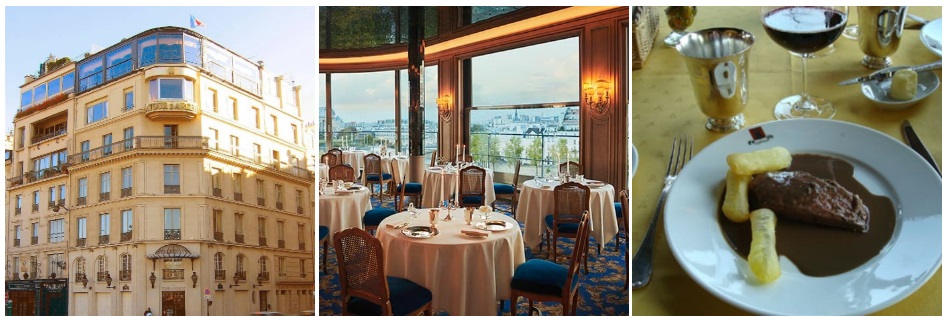
This is a restaurant with Michelin stars – three at a time, but in 1996 it lost one of them, and ten years later it parted ways with another one star. The administration claims that among their former clients are King Henry IV. Franklin D. Roosevelt, Marlene Dietrich and Charlie Chaplin. One thing is for sure, the restaurant has been making Parisian dinners special since 1582.
Zur Letzten Instanz, Berlin, Germany (1621)

Another great place with an impressively long history. And for eating there you will not have to wait so long because you could usually book a table for the next day. Clients in the past included Napoleon Bonaparte, Ludwig van Beethoven, and German Chancellor Angela Merkel.
Although the building is one of the oldest in Berlin, it was renovated in 1963 after being severely damaged during World War II. For this reason, the interior is not entirely authentic, but the current design reflects the style of the original tavern from 1621.
White Horse Tavern, Rhode Island, USA (1673)

The building was built in 1652 and in 1673 was sold to William Mace, who opened a tavern. As the building is quite large, it was used at times as a court, town hall and meeting place for the Rhode Island General Assembly. It even served to separate British and American troops during the American Revolutionary War (1775-1783).
The place was restored in 1954 with a donation from the Von Beren family, and the restaurant reopened in 1957.
Sobrino de Botín, Madrid, Spain (1725)

This is the restaurant that holds the Guinness World Record for being the oldest in the world, although everyone else on our list dates from before this one. The reason for this is the fact that it is located in its original building, with an authentic interior from the 18th century.
It was originally named Casa Botin and was opened by a French chef named Jean Botin and his Austrian wife. The family had no children and therefore bequeathed the restaurant to Mrs. Botin’s niece. It was thus renamed Sobrino de Botin, as in Spanish sobrino means nephew. The list of famous guests includes Ernest Hemingway, Frederick Forsythe, Graham Greene and James A. Mitchener.
********************************************
If you live in Sofia or have a work here, welcome to the Simona restaurant and Art Hotel Simona. We can not boast of such a remarkable story, but on the other hand we have temptingly delicious dishes that will make eating an unforgettable experience.
… Because for us cooking is an art!

Recipe for Delicious Homemade Ice Cream
The dessert we associate with summer is undoubtedly ice cream – there are no two opinions on the matter. Therefore, if you are among the big fans of the ice cream, we challenge you to try a quick option for its preparation at home. And don’t worry, if you have no experience in the kitchen – it is so easy for preparating.
Products:
- 3 eggs;
- 500 ml of fresh milk;
- 2 packets of vanilla;
- 100 g of sugar.
Preparation:
As you can see, there is nothing pretentious. The only more complicated thing is to have the patience to wait it to cool.
It is prepared by placing all the products in a double-bottomed pot. Leave on low heat, stirring, until sugar is melted. Then pour into a suitable container and leave for 24 hours in the freezer.
Interesting fact: Ice cream has accompanied the lives of people for thousands of years. The first such cold dessert appeared in ancient China 5,000 years ago. Chinese emperors mixed snow and ice brought from the mountains and added oranges, lemons, pomegranate seeds, wine and honey. It is believed that this recipe, as well as the method of preparation were kept secret and only in the 11th century were discovered in the book “Shi-king”.

The First Hotel in the World – a Story of More Than 1300 Years
Do you know how old the oldest hotel is? Its name is Nishiyama Onsen Keiunkan, located in Japan and opened its doors for the first time in 705. Sounds impressive, doesn’t it ?!
Background
In fact, the idea of a hotel, although not in its modern form, has existed since the earliest civilizations, because people have always had the need to travel the world. That is why it is difficult to trace the story exactly.
However, researchers claim that the oldest evidence of such a place is from Pompeii from 69 BC. During the Greco-Roman period, as in ancient Persia, similar buildings for rest were made near thermal baths.
The Oldest Still Existing hotel
As already mentioned, this is the Nishiyama Onsen Keiunkan in Japan, which in 2011 was officially recognized by Guinness World Records as the oldest hotel in the world. It was founded by Fujiwara Mahito, the son of an aide to Japan’s 38th Emperor Tenji. It initially began as a traditional Japanese khan and has been owned by the same family for 52 generations.
It is located at the foot of Mount Akaishi and has benefited from the Hakuho hot springs since its inception. After that, healing springs became very popular throughout Japan.
Contemporary Look
Currently, Nishiyama Onsen Keiunkan has 37 rooms and many amenities that were not dreamed of in ancient times – including a restaurant and a special platform for looking of the night sky. Of course, Wi-Fi, tatami mats and the classic furnishings of the rooms, too. However, the hotel is not quite authentic, because in 1997 the owners made major repairs. They retain the traditional architectural style of the original building. In 2005, free-flowing hot water from the springs was introduced into each room.
Unfortunately, the period 2000-2016 is quite difficult for the hotel and its reservations are halved. Therefore, to date, the place is managed by the company Yushima.


