
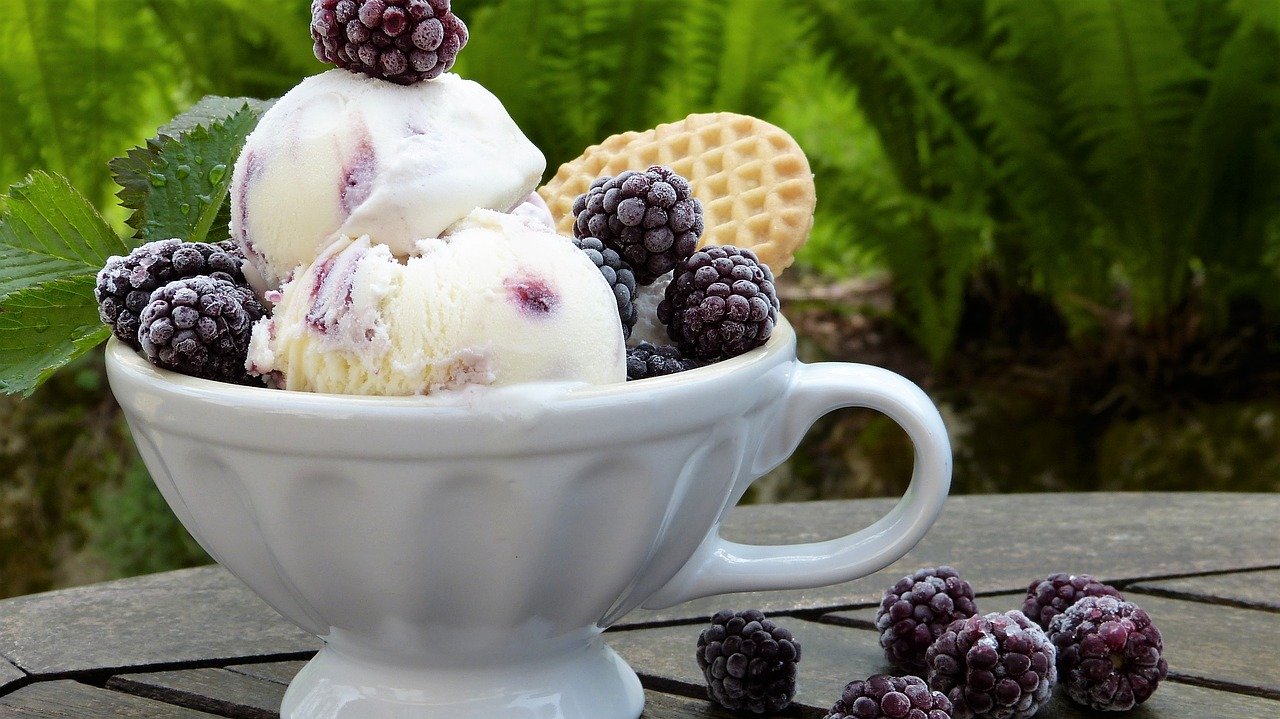
Recipe for Delicious Homemade Ice Cream
The dessert we associate with summer is undoubtedly ice cream – there are no two opinions on the matter. Therefore, if you are among the big fans of the ice cream, we challenge you to try a quick option for its preparation at home. And don’t worry, if you have no experience in the kitchen – it is so easy for preparating.
Products:
- 3 eggs;
- 500 ml of fresh milk;
- 2 packets of vanilla;
- 100 g of sugar.
Preparation:
As you can see, there is nothing pretentious. The only more complicated thing is to have the patience to wait it to cool.
It is prepared by placing all the products in a double-bottomed pot. Leave on low heat, stirring, until sugar is melted. Then pour into a suitable container and leave for 24 hours in the freezer.
Interesting fact: Ice cream has accompanied the lives of people for thousands of years. The first such cold dessert appeared in ancient China 5,000 years ago. Chinese emperors mixed snow and ice brought from the mountains and added oranges, lemons, pomegranate seeds, wine and honey. It is believed that this recipe, as well as the method of preparation were kept secret and only in the 11th century were discovered in the book “Shi-king”.
Top Foods That Never Spoil
Have you ever forgotten a packet of rice or can in the cupboard and remember them in half a year or even more?! Yes ?! Well, don’t worry, you’re not the only one! But are they still good to eat?
Why is it important to know the expiration date?
First of all, it should be clarified that the expiry date does not necessarily mean that the food is unfit for consumption. The dates of “use from” and “sale to” on the packaging are set by the manufacturer to indicate the period during which he guarantees the quality.
What does this mean? Many unopened packages can actually be used. What is important to make sure that everything is fine with the products? Pay attention to an unpleasant odor, change in texture or mold.
Foods that never spoil
Important condition: Store under suitable conditions.
White rice
According to research, it can retain its nutritional value and flavor for 30 years. Of course, there are certain storage requirements, as we already mentioned. It must be in an oxygen-free container at a temperature below 4.5 degrees Celsius.
However, brown rice won’t be good for such a long time because of the natural oils in it. It has been proven that you can use it for up to 6 months.
Honey
This is the only one food that is practically eternal. And this is thanks to its magical ingredients and the work of bees – another proof of how important these small hard-working insects are.
Processing and sealing in jars also contribute to its indefinite shelf life. When heated and filtered honey is sealed properly, moisture cannot be absorbed and it remains unchanged forever.
And something curious: The oldest honey ever discovered is 5,500 years old.
Salt
It is a mineral taken from nature and it has been used for centuries to preserve other foods because it removes moisture. So the salt in the cupboard is actually eternal. What can reduce the shelf life is the addition of iodine, notes Morton Salt. If you use iodized salt, know that you can use it 5 years.
Sugar
Here again we will remind you of the method of storage, because it determines whether the sugar will be eternal or not. Powdered and crystal sugar are best stored in airtight containers to protect it from moisture. For best quality, still use within two years.
Dried beans
As with rice research, dried beans are also considered suitable for up to 30 years. That’s according to researchers at Brigham Young University in the United States. The results show that 80% of the samples are fit for use. It is also claimed that the digestibility of proteins remains stable over time.
Powdered milk
Well, the taste is not as good as real milk, but it can be kept for up to 5 years if it is in a cool, dry and dark place. However, when stored at high temperatures (for example, near the stove), it can spoil in only 3 months.
Water
If it is bottled and you keep it in a dark and cool place, you can be sure that there will be no problem with it. However, the taste changes if it is in the sun, as well as depending on the objects around it.
Soy sauce
If you forget a bottle of soy sauce in the fridge, don’t worry – it is good for use. It can be used to 3 years, even if it is not cold.
**************************
And in case you don’t want to cook a meal at home, we invite you to Simona Restaurant to try some of our irresistible culinary temptations. For us, food is an art that you should enjoy with all your senses.

What is the Correct Way to Arrange a Table?
Have you ever felt confused by the table arrangement of a formal event?! Do you ever think that the cutlery are too many and you are not quite sure in what sequence you should use them? Relax, you’re not the only one, even though as kids, our parents were taught us what etiquette is. However, to help you be prepared and relaxed next time in formal event, we offer you some valuable tips. You can also try to impress the guests at home with them. Your table will definitely look much more stylish.
What to do with glasses, plates and cutlery?
The label requires that we always serve water to our guests and the water glass should be placed above the plate. If you are going to serve wine, then the glasses for red, white and dessert wine should be arranged in a triangle (in the sides under the water glass).
Put a plate and soup bowl in front of each place. Always put a bread saucer on the left side with a butter knife on it, with its handle turned to the right. To the left of the main dish, place the fork for the salad and the fork for the main course. To the right, arrange the knife and the spoon for the soup. It is important to remember that knife blades should point inwards. In addition, the forks and knives are always placed together. The dessert cutlery, however, stand above the centre, where the main plates are, with the fork handle to the left and the spoon handle to the right.
What determines the right table arrangement?
Of course, the proper arrangement is determined by the nature of the gathering and by the number of dishes prepared. Therefore, there are several options (like in the picture). However, if you are a host, keep in mind that you should start eating first. Also, dishes are always served on the left side and removed from the table on the right side. For drinks, the serving is to the right.
If you want your table to look even more beautiful, you can put on a decoration. The basic rule for is to be low so as not to interfere with guest conversations. Whether you put flowers, candles or anything else depends on your personal preference.
A few more highlights:
- The salt and the pepper are on the top left and always put together, even if the guest requested only one of the two spices (above a small saucer for butter or bread);
- The number of dishes should correspond to the number of dishes included in the menu;
- Foods that can be eaten with hands are bread, chips, cookies, sandwiches, asparagus, artichoke, corn, fruit with handles such as cherries;
- When you are between two people at the table, it is appropriate to talk to them both;
- Do not place your phone on the table, although it may be difficult nowadays;
- It is not brought up to ask for the food of others.
**********************
Welcome to Art Hotel Simona where we will make your stay in Sofia unforgettable. And in addition to the modern and cozy atmosphere here, you can also enjoy the incredibly delicious culinary offers at the Simona Restaurant.

Shopska Salad – One of the Favorite Salads of the Foreigners
Bulgaria is popular around the world with its beautiful women, yogurt and rose’s butter. However, there is one more thing – the Shopska salad (also known as Bulgarian salad), which is one of the most consumed in our country. Preparing is easy and all foreigners like this salad. That is why “Shopska salata” (it is bulgarian prononsiation) is among the first phrases that guests learn in Bulgarian language.
How to make Bulgarian salad?
We are sure that every Bulgarian can answer to this question. It contains finely chopped tomatoes, cucumbers, roasted or raw peppers and onions, a little bit oil and a little vinegar, and all is covered with grated or crushed cheese and finely chopped parsley. It looks a lot like a Greek salad, but the vegetables are not wholesale, therefore the different tastes are mixed. However, the Bulgarian salad is an interesting mix of flavors and that is what appeals to everyone.
The history of Bulgarian salad
For the first time, the term „Shopska salad” has been featured in a cookbook since 1940, but in practice it is a recipe for Luthenica (vegetable relish – peppers, aubergines, carrots, garlic, vegetable oil, sugar, salt, and tomatoes). Totally different from the familiar Shopska salad nowadays. It was not until 1956 the recipe of the Shopska salad began to approach our present idea of it, but it is without cheese.
In the years that followed, various variations began to emerge. A cooking book from 1970 shows four options – with onion and cheese; without onions and with cheese; with roasted peppers and cheese; without sweet but with hot peppers and cheese.
The Shopska salad has established itself as a national culinary symbol in the 1970s and 1980s. There is the same salad in Serbian and North Macedonia’s restaurants, too. The salad is also known in Romania under the name Salată bulgărească (Bulgarian salad). Shopska salad is also quite popular in the Czech Republic and Slovakia. It is on the menus of the establishments, but with slight changes – no roasted peppers and sometimes no onions. In Slovakia, they serve the salad with sugar.
How has been the Shopska salad invented?
The idea for the Bulgarian salad is from 60s of the last century. Contrary to expectations, it did not come from a village, but from the Bulgarian state association Balkantourist, whose chefs created it at the Chernomorets restaurant in the then Druzhba resort (now St. Konstantin and Helena).
Fear of red tomatoes
In fact, the village avoided the usege of red tomato because it was considered for bad. Therefore, ripe red tomatoes had been served primarily as animal feed or had been discarded directly. However, such fear is not only a Bulgarian phenomenon, but it has also existed in other Western European countries in the 18th and 19th centuries.
In the Netherlands and Denmark, for example, in the past, red tomatoes had been believed to be poisonous. The reason for this is that the high-lead metal vessels used at that time were widely used. In contact with them, the acid in the tomatoes allows the vessels to secrete harmful substances, which leads to indigestion.

How To Improve Your Mood With… Food
Getting in a good mood can be a challenge, especially in months with less sun. The reduced amount of vitamin D that we take with the sun’s rays is a determinant of bad mood and depression. It also affects the way we make decisions, as well as impulse control. However, here are some ways to improve the situation with food.
Top foods for a better mood
- Rich in Vitamin C
Vitamin C increases immunity, but it also improves mood and relieves symptoms of depression, according to a 2013 study published in The American Journal of Clinical Nutrition. It also helps the body make effective use of carbohydrates, fats and proteins. Therefore, it is good to focuse on using foods that are high in vitamin C.
Foods: citrus fruits, chives and fresh peppers, broccoli, papaya, strawberries, cauliflower, pineapple, kiwi and mango.
- Rich in Vitamin B6
Deficiency of this vitamin can lead to depression, according to other research. Our body needs it to acquire neurotransmitters (substances that improve the functioning of the nervous system) such as serotonin, norepinephrine and melatonin.
Foods: sunflower seeds, pistachios, fish (mainly tuna), turkey and chicken, pure pork, dried fruits (eg plums), bananas, avocados, spinach.
- Rich in Omega-3 fatty acids
Omega-3 fatty acids are extremely useful for our brain and appearance, as well as for our smile. When we do not take enough, signs of depression begin to appear, a number of studies have found.
Foods: salmon, herring, sardines, chia seeds, flax seeds, nuts, veal, eggs, and EPA and DHA derived from algae.
- Rich in zinc
Studies have shown that people with the most severe depression often have low levels of zinc in their body. Its deficiency can lead to symptoms of the disease, as well as memory problems, seizures, aggression and violence.
Foods: legumes, seeds, nuts, whole grains, oysters, red meat, cashew, almonds, chickpeas, pumpkin seeds.
- Rich in magnesium
Magnesium is necessary for the transmission of nerve impulses, for muscle activity, for temperature regulation, for detoxication in the body, and for the formation of healthy bones and teeth. As a result of a comparative study in 1921, it became the first medically recognized substance to treat depression.
Foods: legumes (beans, lentils, nahut, peas), dairy products (mozzarella, goat cheese), whole grains (quinoa, millet, bulgur, wheat), dark leafy vegetables, nuts and seeds (pumpkin seeds, sesame, almonds, cashew nuts, cedar nuts, peanuts, walnuts), fish (salmon, tuna, mackerel), avocados, bananas, dried fruits (figs, plums, apricots, dates, raisins) and black chocolate.

How Much the Different European Nations Eat
Is it true that we are what we eat? So let look at things more generally. How much the different European nations eat? Of course, the appetite and the quality of nutrition are an individual choice for each of us, but we can still make regional generalizations that give a very interesting picture.
Where in Europe people eat most?
Leaders at this list are Belgians with an average of 3,793 calories per day. They are followed by the Austrians with 3784 calories and the Irish with 3591 calories, according to Eurostat statistics. After them in the ranking are France and Germany with respectively 3524 and 3539 (as in Italy) calories per day.
Where in Europe people eat less?
It may seem strange, but Bulgarians are at the forefront with 2877 calories per day. We are followed by Slovakia with 2902, Croatia with 3052, the Netherlands with 3147 and Sweden with 3160 calories.
**************************************************
If you are a fan of the good food, come to Simona restaurant to enjoy the cozy atmosphere here and the incredible taste of our meals. Our mission is to bring pleasure to our guests. That is why we offer you a special menu to meets your high expectations!


