

The Unknown Sofia: Paleontological Museum at Sofia University
The topic of dinosaurs and extinct species is among the most interesting for the children and for the adults too. When it comes to paleontology, however, it seems that we are not familiar enough and many people do not even know that there are such museums so close to them. One of them is the paleontological museum at Sofia University, which we have chosen to present in the “Unknown Sofia” section.
History of the Museum
Under the dome of the North Wing of Sofia University “St. Kliment Ohridski ”the secrets of the distant geological epochs have been hidden for almost 70 years. The place was established in 1956, but is not among the popular places to visit by tourists. The reason for this is not the fact that there is nothing to show, but the unusual location.
The idea for the museum came from the famous Bulgarian geologist Prof. Georgi Zlatarski, who formed the first paleontological collection in the late 19th century. At the beginning of the next century, extremely valuable and rich collections were purchased and so gradually this temple of knowledge began to develop and enrich. In its current form, it was arranged in 1965 and now the collection of materials collected in the course of research activities exceeds 15,000 samples. Among them are a huge number of fossils, rock samples and maps from Bulgaria and neighboring territories.
What Can We See There?
The central place in the collection is for the pride of paleontologists – a restored skeleton of the genus Deinoterium* with impressive dimensions of 7 meters in length and 4.20 meters in height. It is made of authentically preserved bones (more than 90%). Other impressive finds include the remains of a saber-toothed tiger, porcupine, giraffe, tapir and monkey, as well as a fossilized dolphin skeleton found near Balchik.
Where is the Museum?
Address: 15 Tsar Osvoboditel Blvd., Sofia University, North Wing, 5th floor
Opening hours: Monday to Friday from 10:00 until 12:00 am and from 01:00 until 04:00pm.
*Dinoterii (deinoteriums) – an extinct genus of giant mammals related to modern elephants. They disappeared at the end of the last ice age, around 11,000 BC. A well-preserved skeleton was discovered in Bulgaria in 1963 in the region of Haskovo.

A Journey Into the Past: How Sofia Became a Capital of Bulgaria
The history of the largest city in Bulgaria – Sofia, begins long before the creation of our country. The earliest data on the inhabitation of the territory are from the early Neolithic. Over the centuries the city did not stop developing, but it was declared the capital only in 1879.
Before that we can trace interesting events from its prehistory, as well as from the Thracian, Roman and Medieval eras. We will tell you about them some other time, and now let’s follow when and how the city rises to the most important administrative center of the Third Bulgarian State.
Name Development
Today’s Sofia in the past bore different names. The oldest documented is Serdonopolis (translated from Greek “city of the Serds”) and according to researchers the Serds inhabited the area in the first century BC. Emperor Trajan officially gave the city the name Ulpia Serdica, often abbreviated only to Serdica. After the region joined Bulgaria at the beginning of the 9th century, it became known as Sredets, and the name Triaditsa is also used in ancient Greek sources. In the 14th century it was already mentioned as Sofia on behalf of the Church of St. Sophia.
How Did Sofia Become a Capital?
For centuries, Sofia has played a particularly important role as a central center and a natural crossroads connecting East and West. And indeed, as the motto of our capital states, the city is growing, but not aging, and therefore it has more than 7,000 years of history.
After the Liberation of Bulgaria from Turkish slavery, a temporary Russian government was formed with headquarters in Plovdiv, which was significantly larger in terms of population at that time. The head of the temporary administration is the Russian prince Alexander Dondukov-Korsakov, who later moved to Sofia and this became a sign of the future strategic location of the city.
A little later, at the suggestion of Marin Drinov, the city was chosen as the capital of the Principality of Bulgaria (April 3, 1879). This led to a rapid increase in population and Sofia became a large and important political, administrative, economic, scientific and cultural center.
The Early Capital
When Sofia was declared the capital, the population was just over 11,000, and urbanization lagged far behind. At that moment there were only two schools, almost no administrative buildings, and only 3,000 houses. But the situation changed very quickly, because the city had good communication lines and a key location for the construction of the future railway network of the Principality.
Transformation of Sofia
In the same year (1879) the first urban plan of Sofia was prepared by the city engineer S. Amadie, who transformed the city. Some of the most prominent architects and builders at that time came to help build the new look. Bold changes began and the center shifted from the square at Banya Bashi Mosque to the square around the Cathedral “St. King ”(today’s Holy Sunday Church).
The first city architect – the Czech Antonin (Adolf) Kolar, created the Ministry of War, Hotel Bulgaria, the Military Club, etc., and Chitalishte Slavyanska Beseda, the buildings of the Bulgarian Academy of Sciences, the Bulgarian National Bank and the mausoleum of Prince Alexander Battenberg were conceived by the Swiss Hermann Meyer. A famous Viennese architect of Bulgarian origin (Konstantin Jovanovic) designed the building of the National Assembly. The emblematic Eagle Bridge, which is considered the symbolic gate of the city, was designed by the chief architect Kolar and Vaclav Prosek in 1891. The name, as you know, comes from the bronze statues of eagles on the bridge.
********************************
If you have a way to the capital Sofia, welcome to Art Hotel Simona, which is located very close to the city center. We will accommodate you in interesting design rooms and we will make sure that you have eaten well with the specialties in the Simona Restaurant.
We are expecting you!

The Oldest Restaurants in the World (PHOTOS)
Nowadays, new restaurants are constantly appearing, offering a variety of menus and interesting interiors. However, according to research, 60% of them fail in the first year, and 80% of them – in the first 5 years. And yet there are some who have withstood the changes, competition and high demands of customers for many years. That’s why we present 7 of the oldest restaurants in the world, collected by the site oldest.org.
The Oldest Restaurants in the World
St. Peter Stiftskeller, Salzburg, Austria (803)

Would you believe that this place open for the first time in 803?! In fact, this is the year in which the restaurant was first mentioned by an English scholar who served Emperor Charlemagne. So it may have existed before. That is why St. Peter Stiftskeller is considered to be the oldest not only in Europe but in the whole world.
The building in which it is housed has undergone many renovations over time, but much of the original vision has been preserved because it is carved into the stone rocks. And here’s something else quite impressive – people like Mozart and Christopher Columbus had been eat in this inn.
However, do not adjust that you will now be greeted with dishes popular centuries ago. The restaurant serves traditional Austrian dishes with a modern European look from locally produced products. And if you want to try the specialties there, you will probably be able to book a table for the next day.
Zum Franziskaner, Stockholm, Sweden (1421)

Compared to St. Peter Stiftskeller Zum Franziskaner is brand new because it exists since 1421. It was founded by German monks, with the permission of King Eric of Pomerania. The food served in the restaurant combines the German roots of the founders with the aromas of the local Scandinavian cuisine.
However, we must make one clarification – Zum Franziskaner is not located in its original building. However, food and drink have remained the same as nearly 600 years ago. So here you can try a unique country sausage, Bavarian roast pork or venison with some of the typical German beers.
Honke Owariya, Kyoto, Japan (1465)

A little more than 40 years after the appearance of the Swedish Zum Franziskaner the Japanese had opened a similar place. Honke Owariya in Kyoto began operating in 1465 as a confectionery shop, moved from the Owari region. Initially, it became popular with its rice cakes, but gradually began to make Soba noodles (with high-quality buckwheat flour). The real secret of the special taste of this dish of theirs to this day is in the clear water of Kyoto, according to the team of the current restaurant.
La-Tour-d’Argent, Paris, France (1582)
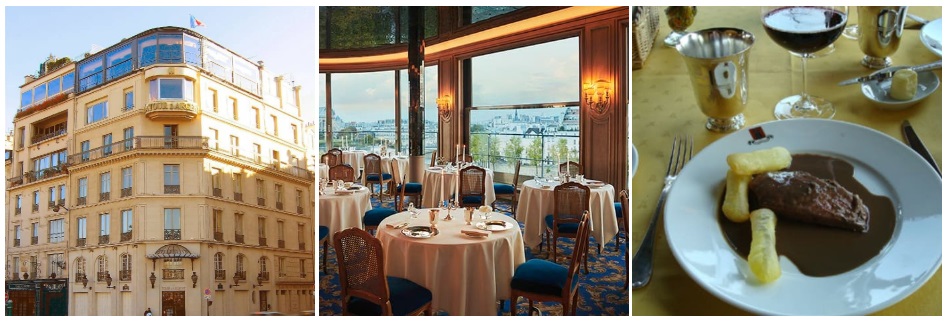
This is a restaurant with Michelin stars – three at a time, but in 1996 it lost one of them, and ten years later it parted ways with another one star. The administration claims that among their former clients are King Henry IV. Franklin D. Roosevelt, Marlene Dietrich and Charlie Chaplin. One thing is for sure, the restaurant has been making Parisian dinners special since 1582.
Zur Letzten Instanz, Berlin, Germany (1621)

Another great place with an impressively long history. And for eating there you will not have to wait so long because you could usually book a table for the next day. Clients in the past included Napoleon Bonaparte, Ludwig van Beethoven, and German Chancellor Angela Merkel.
Although the building is one of the oldest in Berlin, it was renovated in 1963 after being severely damaged during World War II. For this reason, the interior is not entirely authentic, but the current design reflects the style of the original tavern from 1621.
White Horse Tavern, Rhode Island, USA (1673)

The building was built in 1652 and in 1673 was sold to William Mace, who opened a tavern. As the building is quite large, it was used at times as a court, town hall and meeting place for the Rhode Island General Assembly. It even served to separate British and American troops during the American Revolutionary War (1775-1783).
The place was restored in 1954 with a donation from the Von Beren family, and the restaurant reopened in 1957.
Sobrino de Botín, Madrid, Spain (1725)

This is the restaurant that holds the Guinness World Record for being the oldest in the world, although everyone else on our list dates from before this one. The reason for this is the fact that it is located in its original building, with an authentic interior from the 18th century.
It was originally named Casa Botin and was opened by a French chef named Jean Botin and his Austrian wife. The family had no children and therefore bequeathed the restaurant to Mrs. Botin’s niece. It was thus renamed Sobrino de Botin, as in Spanish sobrino means nephew. The list of famous guests includes Ernest Hemingway, Frederick Forsythe, Graham Greene and James A. Mitchener.
********************************************
If you live in Sofia or have a work here, welcome to the Simona restaurant and Art Hotel Simona. We can not boast of such a remarkable story, but on the other hand we have temptingly delicious dishes that will make eating an unforgettable experience.
… Because for us cooking is an art!


